
🔴 Disclaimer:
These simulations were generated using a prototype version of the Gaia Protocol. Results do not yet reflect the full capabilities of the system, which is designed to operate in a high-security, air-gapped environment with HPC servers and DMZ-controlled data flow.
City Overview Panel
City Emblem

Prepared for:
Berlin
Evaluation Date:
July 2025
Gaia Protocol Version:
Alpha 1.6
Population
3900000
Prepared by:
One Terrene International Group via IREDT
Confidentiality Note:

Executive Summary Report
About Gaia Protocol
Gaia analyzes real-world climate plans by simulating:
- 📉 CO₂e reduction potential
- 💸 Cost per tonne and ROI
- 🏥 Healthcare and social co-benefits
- 🏗️ Infrastructure savings and property uplift
- 🌡️ Urban temperature mitigation
- 🧠 Citizen trust and satisfaction outcomes
It does so using:
Verified scientific baselines (IPCC, AR6, WHO, IEA, Eurostat, etc.)
Modular rule logic and impact trees
IoT, satellite, and citizen feedback data streams (when operational)
AI-powered simulation layers tied to ethics-bound regenerative logic
Scorecard Overview Panel
Metric | Original Plan | GAIA Injected (Enhanced) |
|---|---|---|
Target Reduction | 0 | 0 |
Budget | 0 Billion | 0 Billion |
CO₂ Saved | 0 M t | 0 t |
Cost per Tonne | 0 | 0 |
Sectors Evaluated | 0 | 0 |
AI Review |
Metric Charts
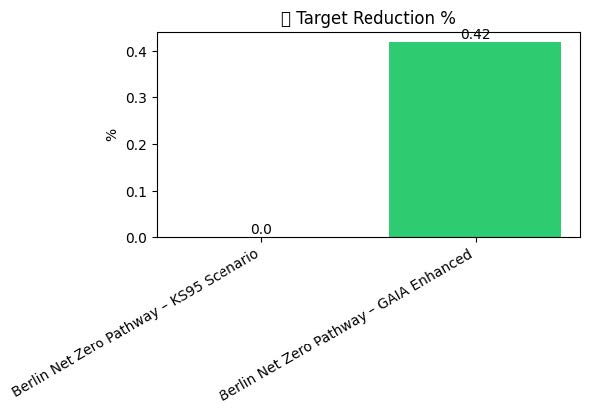
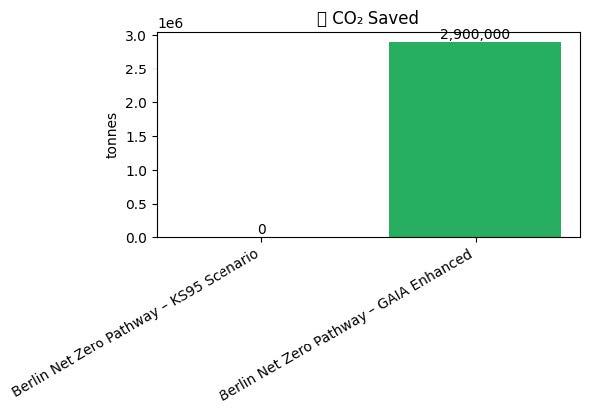
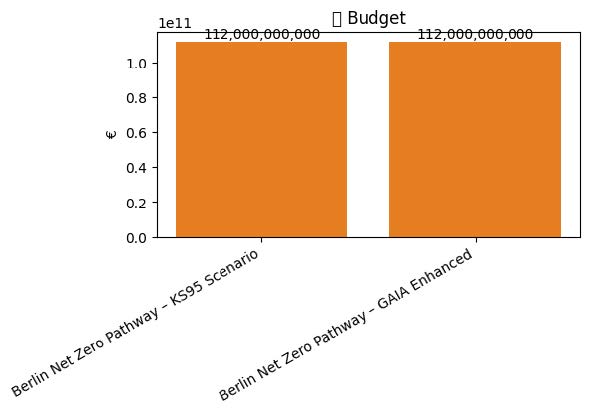
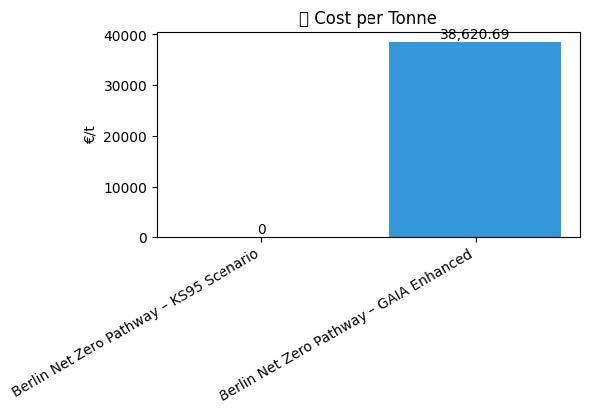
Sector Breakdown
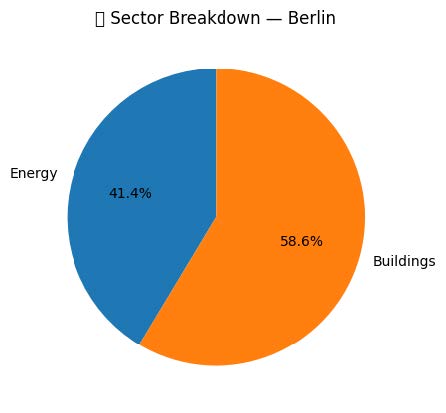
GAIA Protocol Original Plan Evaluation
GAIA Protocol Evaluation - Injected (Enriched)
Simulation using Budget offset Target
Screenshots are from the Prototype Model of the GAIA Protocol platform
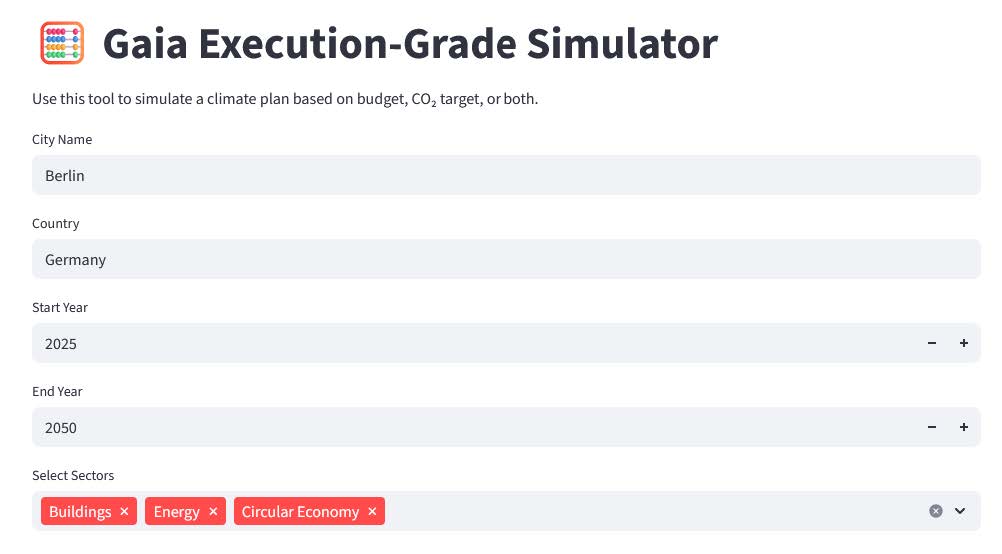
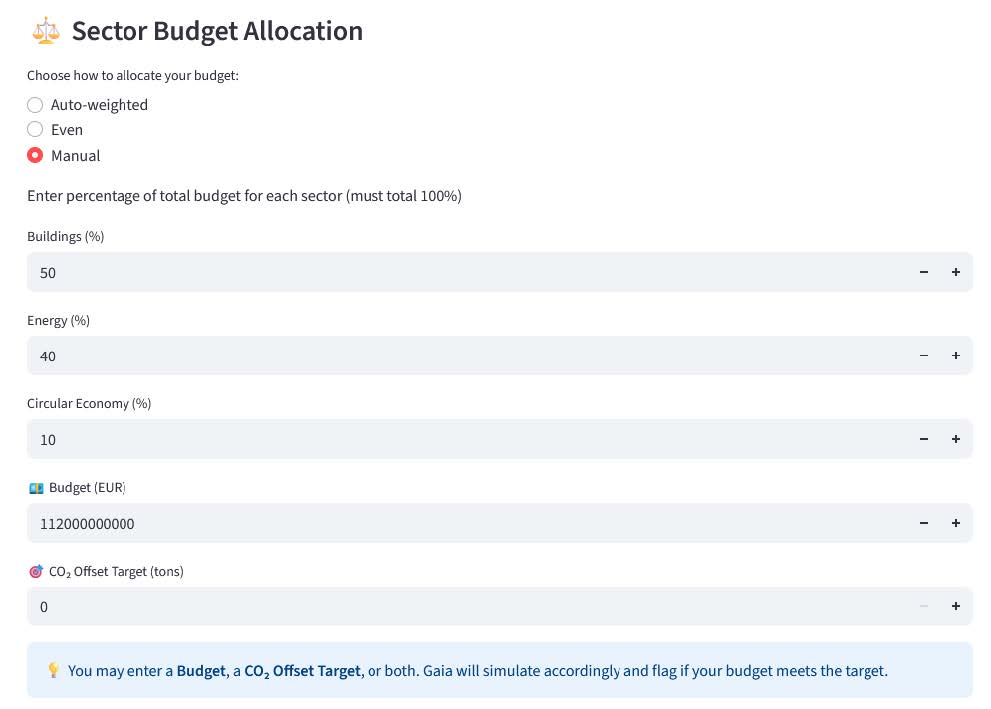


Detailed Actions by Sector
• Deep retrofit for public buildings – 150,000 tCO₂ @ €463,200,000 (€3088/t)
• Subsidised insulation program – 100,000 tCO₂ @ €182,800,000 (€1828/t)
• Deep retrofit of public buildings – Optimized – 10,000,000 tCO₂ @ €2,530,000,000 (€253/t)
• Deep retrofit of public buildings – Heritage-Grade Model (€3000/t) – 5,000,000 tCO₂ @ €15,890,000,000 (€3178/t)
• Deep retrofit of public buildings – Optimized – 10,000,000 tCO₂ @ €2,630,000,000 (€263/t)
• Deep retrofit of public buildings – Historical Conservation Model (€3000/t) – 5,000,000 tCO₂ @ €15,955,000,000 (€3191/t)
• Private building retrofit – Optimized – 12,000,000 tCO₂ @ €6,180,000,000 (€515/t)
• Private building retrofit – Standard – 10,000,000 tCO₂ @ €7,960,000,000 (€796/t)
• Private building retrofit – Ambitious – 8,000,000 tCO₂ @ €6,920,000,000 (€865/t)
Simulation using CO₂ offset Target
Screenshots are from the Prototype Model of the GAIA Protocol platform
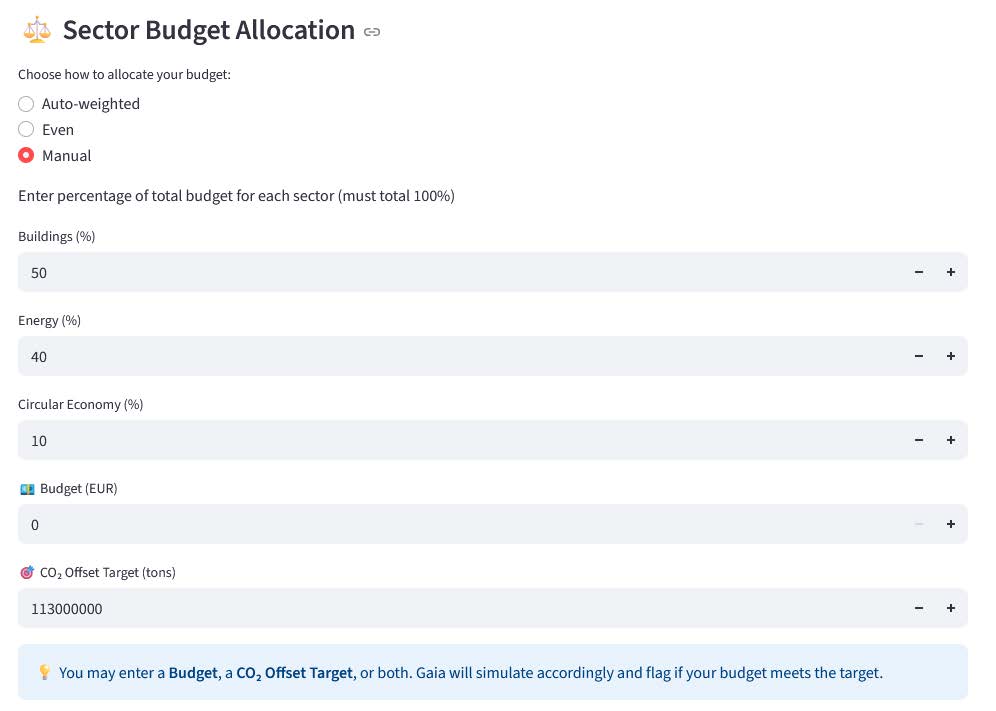

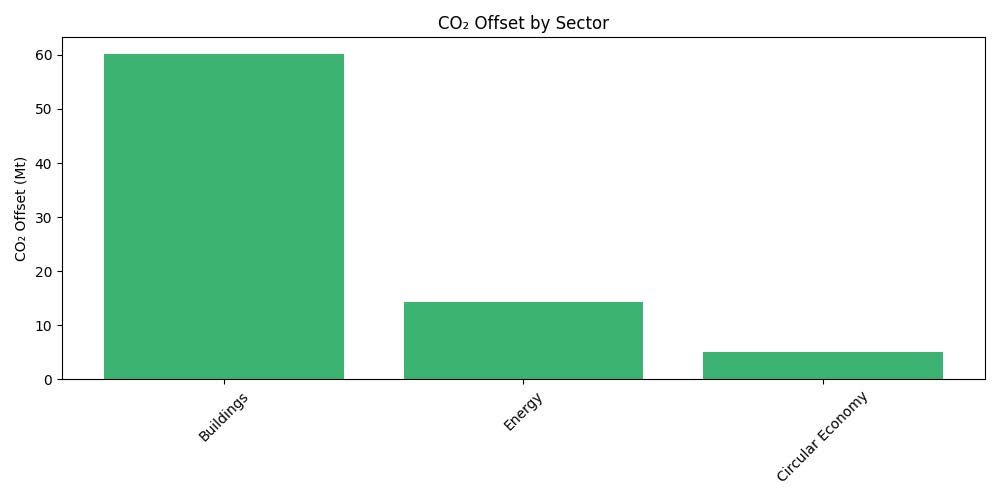


Detailed Actions by Sector
Simulation using Budget and CO₂ offset Target
Screenshots are from the Prototype Model of the GAIA Protocol platform
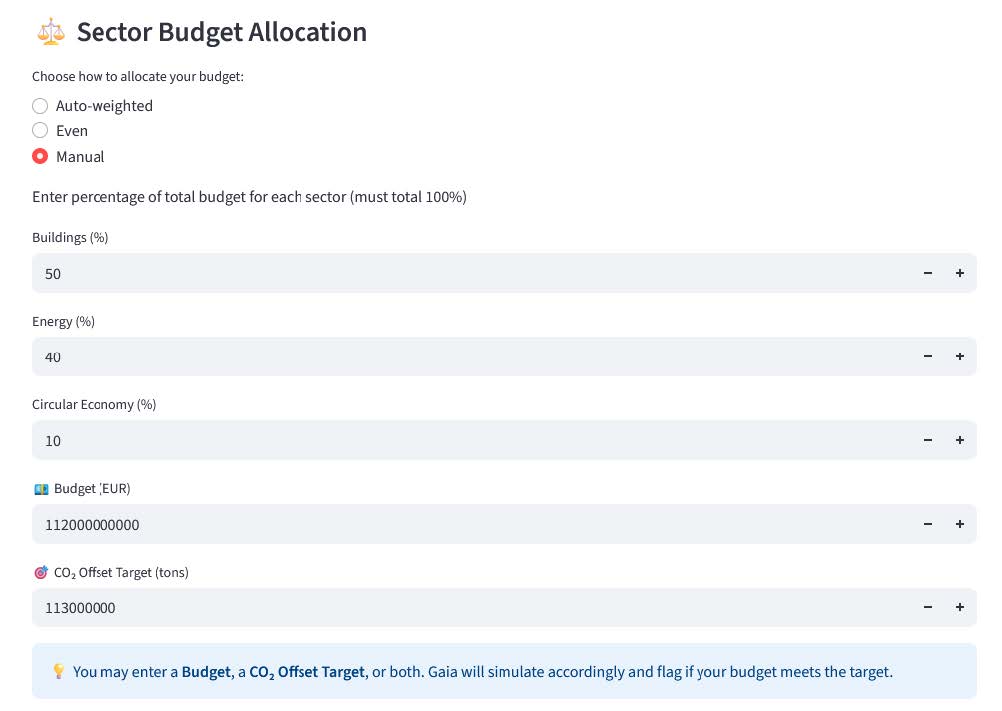


Detailed Actions by Sector
• Deep retrofit for public buildings – 150,000 tCO₂ @ €458,250,000 (€3055/t)
• Subsidised insulation program – 100,000 tCO₂ @ €179,800,000 (€1798/t)
• Deep retrofit of public buildings – Optimized – 10,000,000 tCO₂ @ €2,470,000,000 (€247/t)
• Deep retrofit of public buildings – Heritage-Grade Model (€3000/t) – 5,000,000 tCO₂ @ €14,040,000,000 (€2808/t)
• Deep retrofit of public buildings – Optimized – 10,000,000 tCO₂ @ €1,830,000,000 (€183/t)
• Deep retrofit of public buildings – Historical Conservation Model (€3000/t) – 5,000,000 tCO₂ @ €14,075,000,000 (€2815/t)
• Private building retrofit – Optimized – 12,000,000 tCO₂ @ €7,092,000,000 (€591/t)
• Private building retrofit – Standard – 10,000,000 tCO₂ @ €7,750,000,000 (€775/t)
• Private building retrofit – Ambitious – 8,000,000 tCO₂ @ €6,808,000,000 (€851/t)
Download & Contact Section
Request Full Report (PDF)
- Budget Only Simulation
- CO₂ Target Simulation
- Budget + CO₂ Simulation Each tab includes:
- Strategic Summary
- ROI metrics
- Offset per year chart
- Sector pie charts
- Action lists (with cost/tCO₂)